


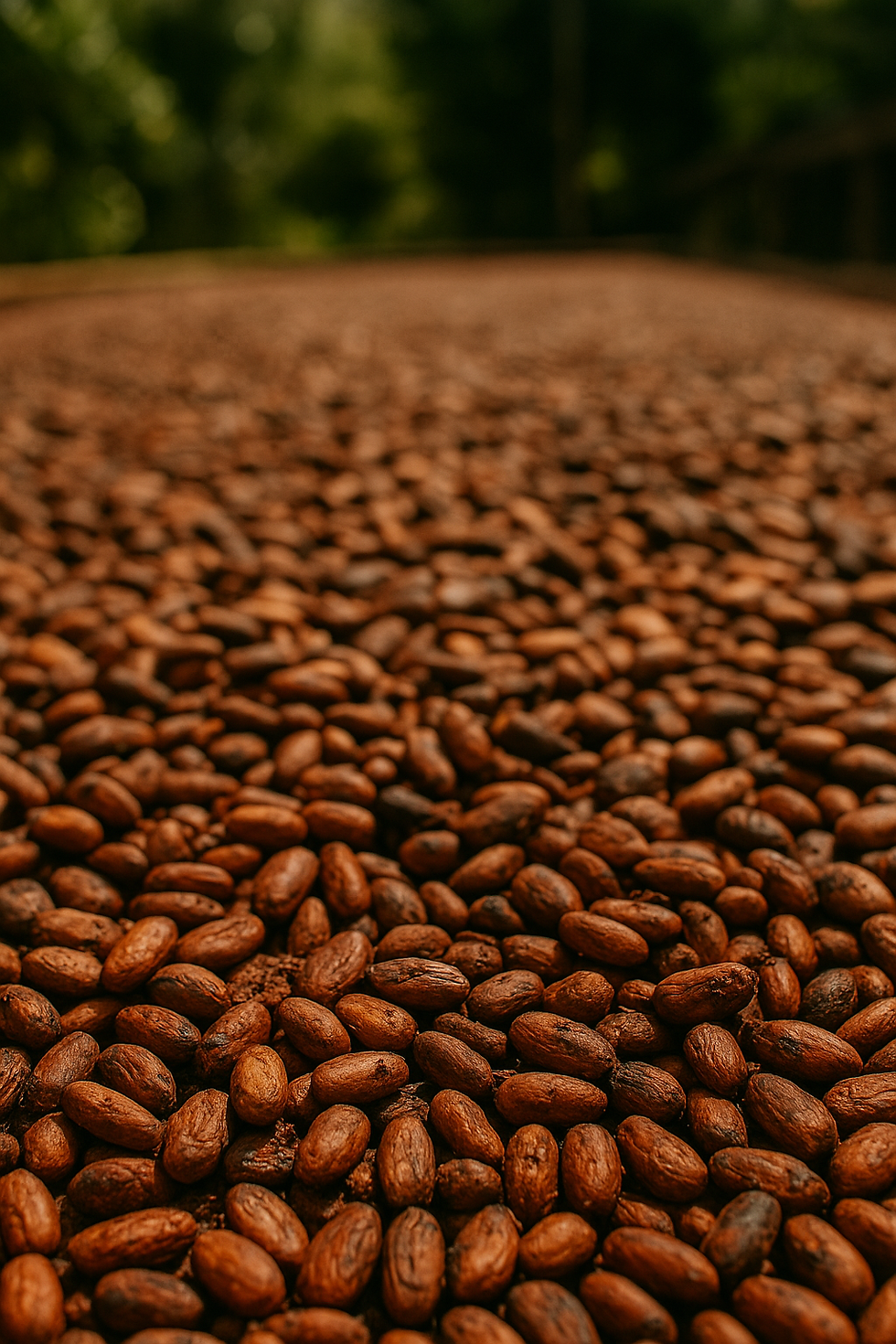

Sun Drying — Preparing Cacao for Its Journey

TRANSFORMING CACAO · PART 3
After fermentation, cacao still needs careful drying before it can travel or wait in storage. This is a processing step in its own right: the producer manages water removal while protecting the flavor potential built during fermentation.
The target is a range, not maximum dryness
Industry guidance places finished bean moisture near 7%. Above 8%, mold and bacterial growth become concerns; below about 6.5%, shells become brittle and beans break more easily. Those figures describe commercial quality targets, not a guarantee that a batch is safe merely because a meter displays the right number. [1]
A useful question is therefore not “Are these beans dry?” but “How evenly have they dried, and what happened along the way?” A surface observation cannot tell the whole story of a batch.
Water and acidity do not leave at the same speed
Fermentation introduces acids into the bean. During drying, moisture and volatile acids must move through its tissues and shell. A controlled study of drying at 40–60°C found that acetic, propionic and butyric acids diffused more slowly than water, both with and without the shell. [2]
That distinction explains why faster water removal is not automatically better flavor development. A process can reduce moisture quickly while leaving a different acid balance behind. It also explains why a drying recipe needs more than a temperature: time, airflow, bean condition and the structure of the bean all matter. The study measured transport under experimental conditions; it did not establish one universal farm schedule.
What good sun drying asks of the producer
Industry guidance recommends beginning promptly after fermentation, spreading beans on clean, elevated drying surfaces, and turning them regularly. Layers should stay shallow enough for air circulation; the guide gives a maximum depth of about 6 cm. Beans need protection from rain and nighttime dew, and batches at different drying stages should remain separate. [3]
Weather sets the pace. The guide describes roughly six to ten days under suitable sun-drying conditions, while emphasizing local circumstances. Prolonged wet conditions encourage mold; excessive heat or rushed drying can retain acidity. The aim is controlled progress, with observation and measurement replacing a fixed calendar deadline. [3]

Does mechanical drying necessarily mean poorer cacao?
No single equipment label tells the whole story. In a 2025 Ghanaian experiment, researchers compared open sun drying, conventional convective oven drying, and a modified oven process designed to reproduce sun drying's temperature and humidity pattern. The modified process and sun drying produced more similar chemical profiles than the conventional oven treatment. [4]
The finding matters because it shifts attention to how the beans experience drying. Temperature and humidity control can be as important as whether the heat comes directly from sunlight. The authors identified promise for unfavorable weather, while calling for further work on sensory quality and other outcomes. One experiment does not prove that every mechanical dryer performs equally well.
Where fuel supplies heat, equipment must prevent smoke and combustion gases from contacting the beans. Clean drying protects against unwanted flavors and contamination as well as excess moisture. [3]
From the drying bed to the next transformation
Drying is the handoff between farm processing and the later work of the maker. A well-managed batch preserves possibilities; poor drying can narrow them before a roaster ever receives the beans. In the next chapter, we follow those dried beans into roasting.
Explore this stage
Sources
Image credits
Process photograph: MayorParis, “Cocoa beans on a dryer,” 2023. Reproduced without alteration. Cover artwork uses that photograph as a reference; the adapted cover is also shared under CC BY-SA 4.0.


Comments