


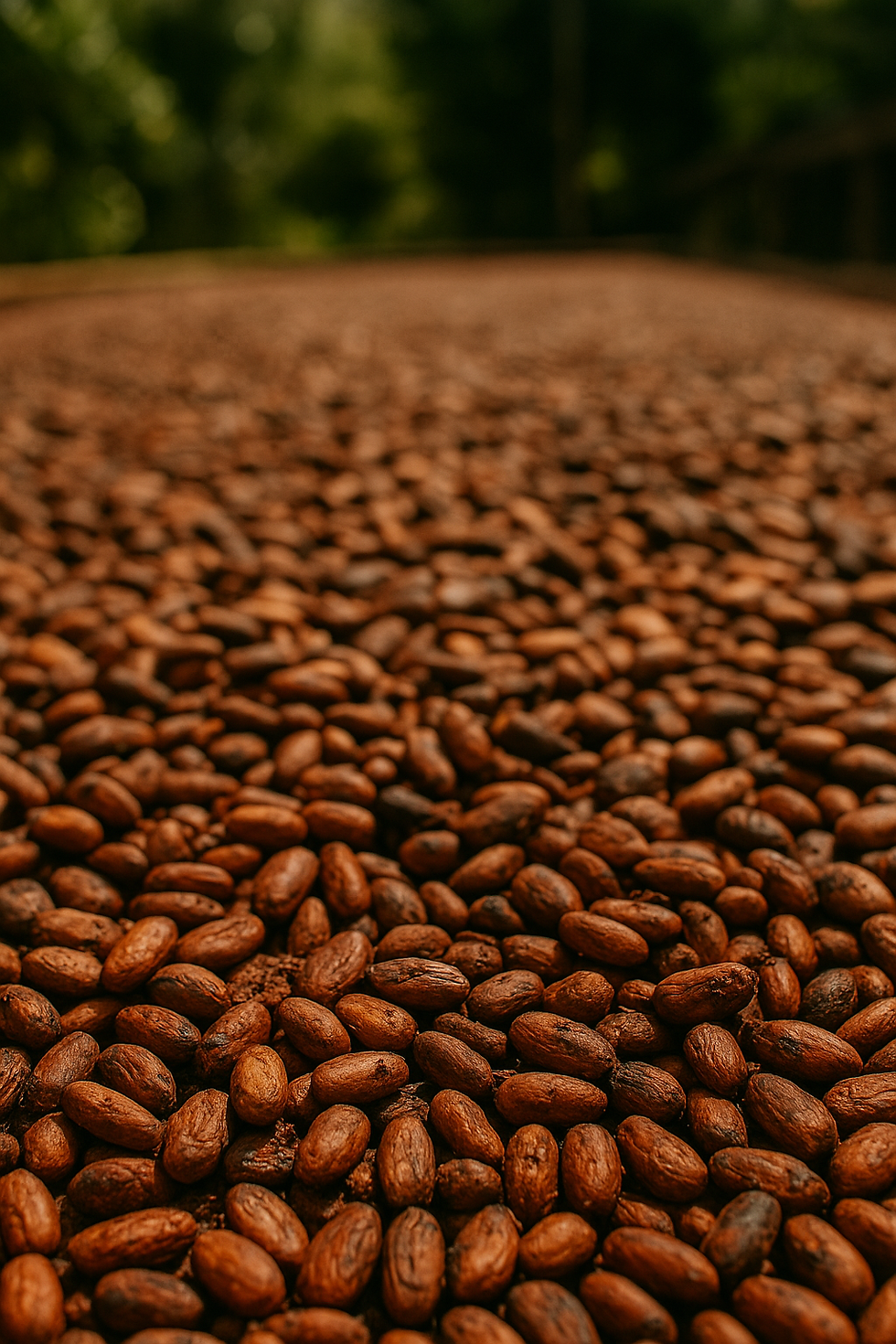

Roasting — Bringing Flavor into Focus

TRANSFORMING CACAO · PART 4
Growing, fermentation and drying establish the material a maker receives. Roasting changes it again. The goal is to develop a chosen flavor profile while controlling the process consistently—not simply to make every bean darker.
Heat works with what the farm has already created
Roasting promotes reactions between amino compounds and reducing sugars, including the Maillard reactions associated with characteristic cocoa aromas. Research on roasted cacao also tracks changes in phenolic compounds and theobromine. Those chemical measurements describe different parts of the transformation; no single number is a complete measure of quality. [1]
A study measuring alkylpyrazines, color, polyphenols and sensory characteristics found substantial effects of both roast time and temperature. Its highest-scoring treatment also had the lowest measured polyphenol content among the tested samples. That illustrates a tradeoff: preserving the greatest quantity of one chemical group and creating a preferred flavor are not necessarily the same objective. [2]
A roast profile is a relationship between time and temperature
A short, hotter roast and a longer, cooler roast expose cacao to different histories. In a study of 27 treatments across three origins, 145 chocolate consumers evaluated unsweetened chocolate. Adjusting roasting reduced perceived bitterness, sourness and astringency, and those reductions were associated with greater liking. The researchers also emphasized the starting cacao's origin and sensory characteristics. [3]
This does not establish one ideal setting for every bean. It shows why a maker compares profiles on the actual material. A result from one origin, batch size or apparatus cannot be copied as though the temperature displayed on a different machine describes an identical process.
Whole-bean roasting and nib roasting
Our series follows whole beans through roasting before cracking and winnowing. That is one route. Manufacturers also roast nibs after removing the shell; Ghirardelli, for example, describes nib roasting in its own production process. Industrial equipment suppliers offer both continuous and batch systems for different processing needs. [4, 5]
The sequence therefore needs to be read with the product and equipment in mind. A process diagram is a useful map, but it should identify which route it represents. Neither whole-bean nor nib roasting, by itself, tells you whether the resulting cacao will taste good.
Flavor development and microbial control are separate questions
Roasting can serve as an important microbial reduction step, but a pleasant aroma is not evidence of a validated safety process. Yan and colleagues studied Salmonella inactivation on whole cacao beans under conditions relevant to fine chocolate production. Their findings were intended to inform validation, including work with suitable nonpathogenic surrogate organisms. [6]
For a producer, the practical distinction is essential: sensory trials decide whether a roast suits the intended flavor; process validation establishes whether the equipment and operating conditions achieve the required microbial control. A published experimental time and temperature should not be treated as a universal safety instruction.
How to compare roasts thoughtfully
For useful trials, keep the cacao lot and the later preparation consistent, record the batch size and machine settings, and label samples so they can be tasted without knowing which roast produced them. Record cocoa intensity, acidity, bitterness, astringency and any burnt notes separately. This is a comparison framework, not a prescribed roast recipe.
Ask what changed and whether that change serves the intended product. A profile suited to a sweet chocolate may not give the same balance in an unsweetened cacao drink. The next chapter follows the whole-bean route into cracking and winnowing, where the shell is separated from the nib.
Explore this stage
Sources
Artwork credit
Cover artwork uses MayorParis's photograph of whole cacao beans as a physical reference. The adapted cover is shared under CC BY-SA 4.0.


Comments