


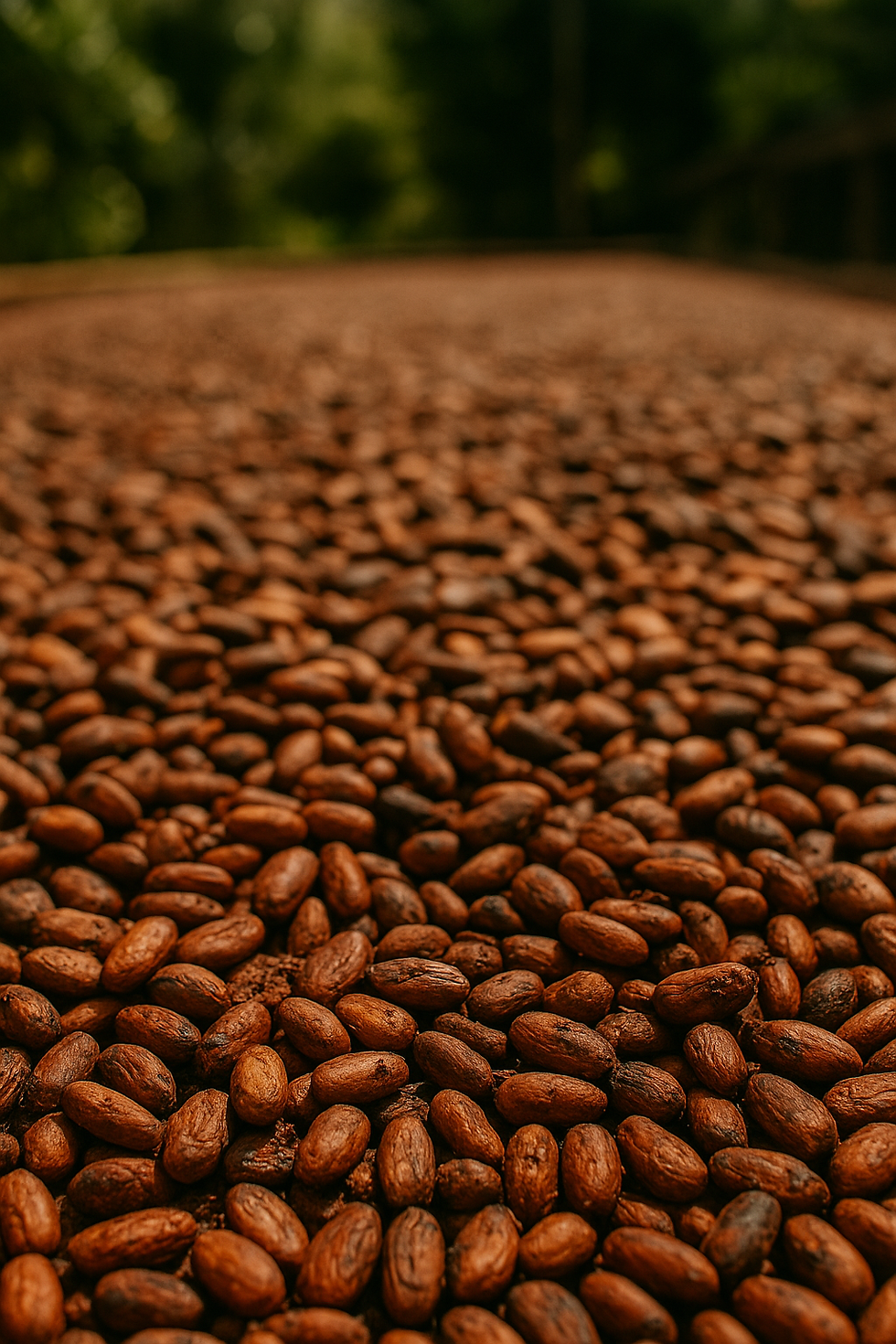

Fermentation — How Cacao’s Flavor Begins

Updated: Oct 22
TRANSFORMING CACAO · PART 2
A harvested cacao seed has not yet developed the full flavor potential a chocolate maker needs. Fermentation begins in the fruit pulp around it. Microorganisms change that environment, while heat and acids help transform the seed itself. Understanding both locations—the pulp outside and the tissue inside—makes the process much easier to follow.
A community with overlapping jobs
Yeasts, lactic acid bacteria, and acetic acid bacteria play major roles. Yeasts turn pulp sugars into ethanol and other metabolites. Lactic acid bacteria consume substrates including sugars and citrate. Acetic acid bacteria use oxygen to oxidize ethanol into acetic acid, releasing heat. These activities overlap rather than changing shifts at precisely timed boundaries. [1]
Research on small-scale Brazilian fermentations followed both the microbial populations and their metabolites, then screened strains for potential starter cultures. This matters because naming a species is only the beginning: individual strains differ in their ability to tolerate heat, acid, and ethanol and in what they produce. [1]
Why the batch gets hot
The microorganisms are metabolically active, so a fermenting mass can warm substantially without a roaster. Industry guidance describes temperatures approaching 50°C in the mass. A tiny handful loses heat differently from a full fermentation box; copying the duration of a large batch does not reproduce its conditions. Small experimental fermentations need methods designed for their scale. [2]

What changes inside the seed
Acids and heat alter the seed environment. Internal reactions help form the chemical building blocks used in later aroma development. Fermentation and drying also create or modify flavor-active molecules. In other words, fermentation contributes flavor directly while also preparing material for roasting. [3]
A Costa Rican study compared yeast treatments through fermentation and into chocolate. Different strains changed metabolite production and the resulting flavor profiles. The result supports a careful conclusion: fermentation choices can influence the finished product, but a promising culture is not a universal flavor guarantee. Cacao material and the later processing steps still matter. [3]
Boxes, heaps, drainage, and turning
Beans may ferment in heaps or boxes. The setup needs protection from rain and a batch size suited to the method. Sorting out diseased beans, husk fragments, and placenta before filling helps keep the starting material consistent. Equipment should be maintained clean between batches. [2]
Turning mixes the mass and changes access to oxygen. That affects the organisms working in it, so turning is a process variable rather than a ceremonial daily chore. Industry protocols for flavor-testing samples use different schedules for different cacao types and explicitly note that both turning and the endpoint vary. [4]
How does a producer know when to stop?
A calendar is useful as a record, but it is not the whole diagnosis. Experienced producers combine the batch history with smell, appearance, temperature observations, and examination of cut beans. Under-fermentation can leave an excessively bitter, astringent material; extending a batch too far can introduce undesirable flavors. More fermentation is not automatically better. [2]
For a producer comparing batches, a useful notebook records the cacao source, wet-bean quantity, container, start time, turning times, measurement locations, and observations. Keep the measuring routine consistent so differences between batches are interpretable. This is a practical way to organize observations, rather than a substitute for a locally validated fermentation protocol.
The next transformation
Once the intended endpoint is reached, drying becomes the priority. It reduces water while further changes continue in the beans. The aim is to preserve the work already done and prepare cacao for the journey to the maker.
Previous chapter: Growing & Harvesting.
Explore this stage
Sources
Image credit
Scot Nelson — Fermentation of cacao seeds · CC0 public-domain dedication. Original process photograph; also used as the botanical and equipment reference for the cover artwork.


Comments