


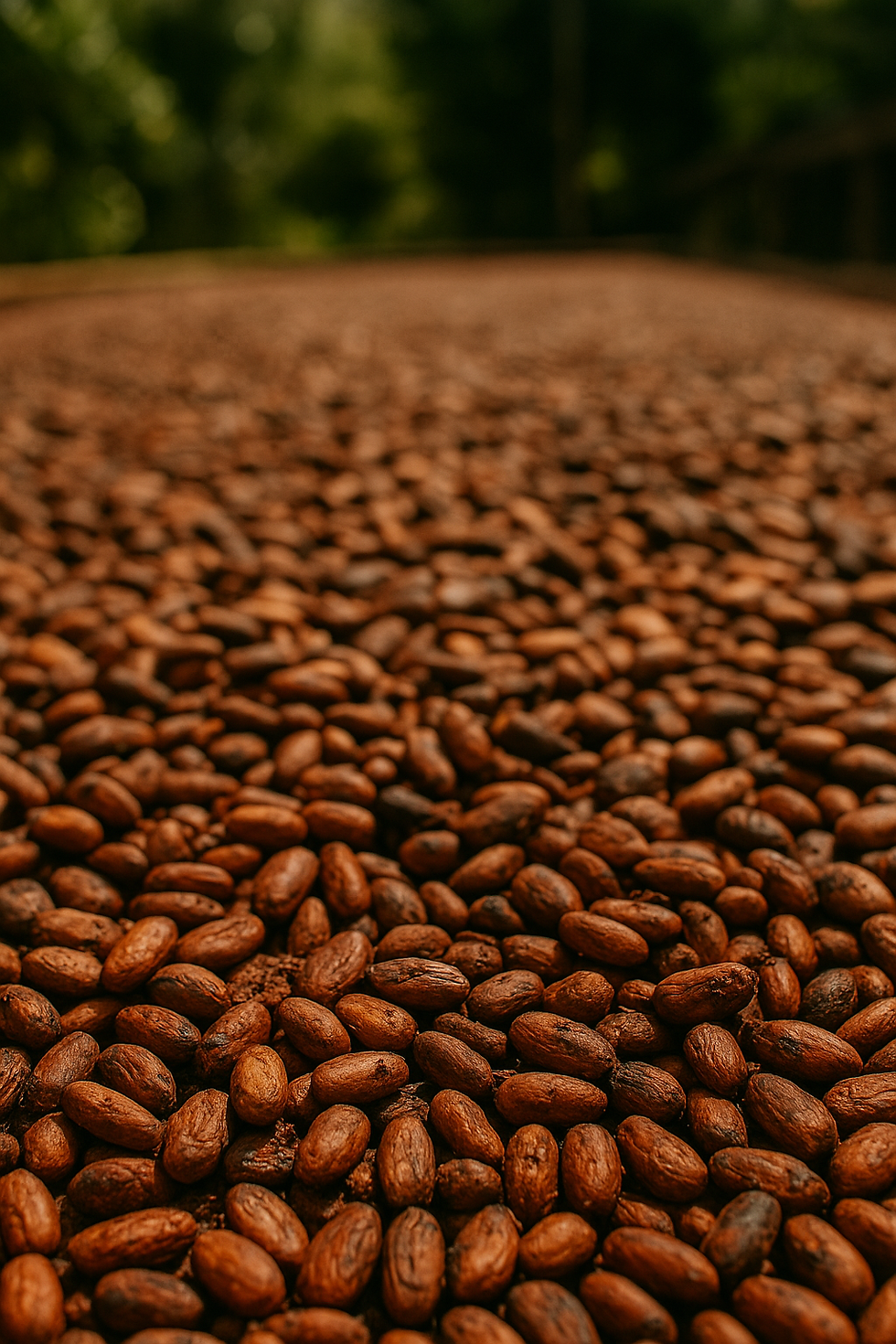

What Does “Raw Cacao” Actually Mean?

TRANSFORMING CACAO • FIELD NOTES
“Raw cacao” sounds like a precise description. To understand a particular product, however, we need more information: was it fermented, how was it dried, was it roasted, and which temperatures were measured? Those questions tell us more than the word alone.
Unroasted and unheated are different claims
A supplier may use a temperature limit as part of its own description. For example, Sevenhills Wholefoods states that processing temperatures for its raw cacao beans do not exceed 45°C. That is a claim about that product, not a temperature history we can automatically assign to every cacao labeled raw. [1]
Fermentation itself generates heat. In a study of fine-flavor cacao fermentation, researchers recorded a later phase between 45 and 50°C. A bean can therefore have experienced substantial warmth before any roasting step begins. This observation does not establish the history of every commercial product; it explains why “not roasted” cannot by itself mean “never warmed.” [2]
Ask which stage the description covers
A useful processing description follows the cacao from harvest through fermentation, drying, any microbial-reduction treatment, and grinding. Ask whether a temperature claim refers to the product itself or the surrounding equipment, and whether it covers farm processing as well as the maker’s workshop.
This is especially relevant to a purchased ingredient. A maker can accurately describe what happens in their own equipment while still needing records from the supplier to describe earlier stages.
Temperature does not produce one simple chemical outcome
Roasting changes cacao chemistry, but “heat destroys everything” is not an accurate summary. Hermund and colleagues measured selected flavonoids and theobromine in three cacao samples under different roasting conditions. Responses varied with the compound, bean sample, time and temperature; some measured concentrations increased under particular conditions. [3]
That experiment does not prove that one process is always healthier or that its preferred setting suits every cacao. The authors also noted that sensory evaluation was needed to establish how the resulting product would taste. Claims about a finished product’s composition require measurements of that product, not just a raw or roasted label. [3]
Flavor processing and safety are separate questions
Cacao of Excellence cautions that unroasted beans are agricultural raw materials that may carry pathogens. Its sensory roasting protocols are also not a guarantee of eliminating microbiological hazards: the starting contamination matters. [4]
For production, ask what validated controls make the ingredient suitable for its intended use. A pleasant aroma, a low-temperature claim, or the absence of visible mold does not answer that question. Nor should a home preparation be treated as a substitute for a producer’s validated process.
Read the process behind the label
The most informative description names what actually happened. Fermented and unroasted; roasted under a documented profile; ground with controlled product temperature—each gives a reader something concrete to understand. “Raw” becomes useful only when the maker explains its meaning and scope.
Explore Fermentation — How Cacao’s Flavor Begins and Roasting — Bringing Flavor into Focus for the science behind those stages.
Sources
Cover artwork based on Scot Nelson’s public-domain (CC0) fermentation photograph, Fermentation of cacao seeds.


Comments