


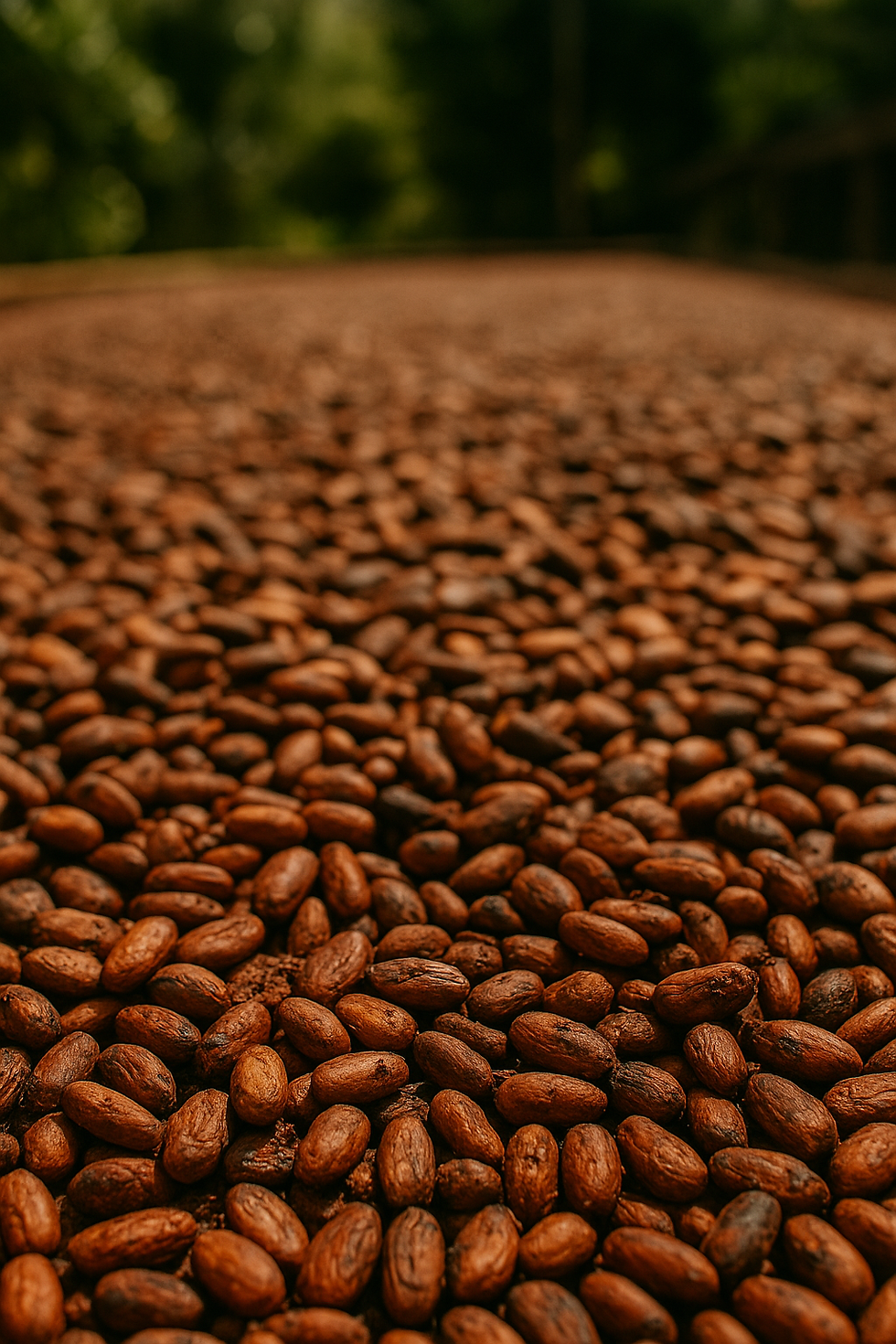

Cracking & Winnowing — Revealing the Nib

TRANSFORMING CACAO · PART 5
After roasting whole cacao beans, the maker needs the edible interior for grinding. Two operations do that work: cracking breaks the bean, and winnowing separates the fragments of shell from the nib. Breaking something apart is straightforward; separating it well takes control.
Cracking opens the bean without trying to make powder
The immediate goal is a useful distribution of pieces, not the finest possible grind. Bühler's industrial system illustrates this with two crushing stages: a gentler first pass and a stronger second pass for beans that remain unopened. Crushing intensity can be adjusted for the incoming material. [1]
That design makes a useful principle visible: beans do not all break identically. A setting that opens one lot efficiently may produce excessive small fragments in another. The operator is preparing material for separation, so the quality of the next step matters as much as the appearance of the cracked beans.
Air separates materials that behave differently
A winnower combines mechanical breaking with separation. Selmi describes a mill followed by two adjustable airflows, with separate collection of nibs and shell. [2] The air system must remove shell while retaining as much useful nib as possible.
Industrial systems often sort the cracked material by size before adjusting airflow to each fraction. The industry's sample-preparation guide explains that this sizing improves separation; small laboratory systems without it can lose more nib. [3]
The practical lesson is to examine both output streams. Clean-looking nibs are only half the evidence. If useful nib is being carried away with the shell, a tidy product stream may hide a poor yield.
Two measurements belong together
The two questions are: how much shell remains with the nibs, and how much nib is lost with the shells? Equipment that combines sieving and aspiration gives the operator ways to adjust that balance. Bühler's system uses configurable sieve decks and vacuum control to accommodate differences in throughput and bean condition. [1]
For a small producer, recording input weight, recovered nib weight, visible residual shell and nib in the rejected material makes trials more informative. Compare like with like: a yield measured from roasted beans is not directly interchangeable with one calculated from the original unroasted batch.

What comes out is cacao nibs
Nibs are the broken interior of the cacao seed. They are an intermediate ingredient that can be sold as pieces or ground into cacao mass. At this stage they still have their natural cacao butter; winnowing is shell separation, not fat extraction.
Their irregular fragments are quite different from manufactured chocolate chips. The photograph above is useful because it shows the actual material: different sizes, fractured surfaces and natural color variation.
Protect the material after separation
The industry guide cautions that nibs readily take up surrounding odors and moisture, and recommends sealed, suitable containers during sample handling. It also describes manual removal of residual shell for flavor evaluation. [3]
That advice helps explain why good separation and careful handling belong together. The next chapter follows clean nibs into grinding, where their own fat helps turn a collection of solid fragments into flowing cacao mass.
Explore this stage
Sources
Image credit
Nibs photograph by Ll1324, reproduced without alteration and used as the physical reference for the cover artwork.


Comments