



History of Cacao: Part 1 — The 5,300-Year-Old Discovery

Updated: Oct 22
PART 1 • INDIGENOUS ROOTS • THE UPPER AMAZON
Before cacao traveled through markets, courts, and empires, people learned to live with a tropical tree. They gathered its fruit, worked with its seeds, and made it part of their food and social worlds. Our History of Cacao series begins with the traces of that relationship: evidence from southeastern Ecuador dating back approximately 5,300 years.
The place is Santa Ana–La Florida, near Palanda. The discovery became widely known through a study published in 2018. Tiny remains preserved on ancient objects helped researchers recognize cacao in a setting far earlier than the familiar stories of Maya drinking vessels or European chocolate houses. [1][2]

The discovery at a glance
Where: Santa Ana–La Florida, in the upper Amazon region of southeastern Ecuador.
Who: the community associated with the Mayo-Chinchipe archaeological culture.
When: cacao evidence dating to approximately 5,300 years ago.
How: microscopic starch grains, theobromine residues, and ancient DNA.
Why it matters: the findings moved the archaeological starting point for cacao use deeper into South America’s Indigenous past. [1][2]
1. Begin with the place and its people
“Amazon” can bring to mind a vast, flat expanse of rainforest. The upper Amazon also includes the eastern foothills of the Andes: slopes, river valleys, and humid forests at different elevations. Santa Ana–La Florida belongs to this meeting of mountain and forest landscapes. Francisco Valdez’s archaeological account places the site within the Mayo Chinchipe–Marañón drainage and examines cacao as part of the community’s social life. [3]
That setting matters. A forest is a lived landscape to the people who know it. Fruit trees, waterways, paths, and cultivated spaces can carry generations of knowledge. Asking how cacao became useful means asking about people’s choices: what they gathered, what they tended, what they prepared, and what they passed on.
The 2018 paper describes a small village with roughly twenty buildings around a sunken plaza, and a platform with a circular structure and burials. Archaeologists investigated objects from several kinds of context, including ceremonial, funerary, and residential settings. Cacao’s traces belonged within that human environment. [1]

The term Mayo-Chinchipe helps archaeologists discuss related material traditions. It does not give us a complete account of what the inhabitants called themselves or how every household lived. Their pottery and buildings preserve some aspects of their world; other parts remain beyond our view.
2. How do you recognize a drink after thousands of years?
A vessel can survive long after its contents disappear. Microscopic particles and absorbed residues can sometimes remain, giving researchers something to test. At Santa Ana–La Florida, the investigation brought different kinds of evidence together. Each answered a different part of the identification question. [2]

Starch: a microscopic trace of the plant
Starch grains are tiny structures plants produce to store energy. Their shapes can help identify plant material when compared with reference samples. The study identified grains characteristic of Theobroma, the genus that includes cacao. This is a botanical clue, interpreted alongside the other evidence. [1]
Theobromine: a chemical trace
Theobromine is one of cacao’s characteristic compounds. Detecting its residue adds a chemical line of evidence to the microscopic one. A chemical result becomes more useful when researchers consider the plants that could account for it and the archaeological setting in which it occurs. [1][2]
Ancient DNA: a genetic trace
The team also recovered genetic material attributable to Theobroma cacao. This helped narrow the identification beyond a general resemblance between ancient starch and a modern reference sample. The strength of the investigation comes from these complementary methods, rather than from treating one intriguing mark as a complete answer. [1][2]
Think of the distinction this way: the object tells us where to look; the laboratory evidence helps tell us what contacted it; the archaeological context helps us interpret that contact. None of those steps works as well in isolation.
3. What does “5,300 years ago” actually mean?
It is an approximate age for surviving evidence of cacao use. It is not a recorded birthday for chocolate, nor the name and date of the first person to taste the fruit. Archaeological discoveries establish that a practice existed by a certain point. Earlier uses may leave no recognizable remains.
There are also two timelines in this story. One belongs to the ancient community. The other belongs to modern research. The cacao evidence is thousands of years old; the major scientific publication appeared in 2018. Keeping those dates separate makes the discovery easier to understand. [1]
A useful distinction is between three questions: where the plant evolved, when people began using it, and how people changed it through cultivation and selection. Those questions overlap, but each requires its own evidence.
4. From a forest fruit to a plant people tended
Valdez describes the upper Amazon as a landscape in which people cultivated selected plants and moved them between environments. Over generations, such actions could change both cultivated landscapes and plant populations. This gives domestication a human scale: repeated decisions about useful plants, rather than a single moment of invention. [3]
Harvesting a fruit, planting its seed, and selecting trees with desirable qualities are different activities. The Santa Ana–La Florida findings contribute to an argument for early cacao domestication in the upper Amazon. A particular residue, on its own, cannot show every step by which a community managed its trees. [1][3]
That distinction makes the people in this history more interesting. We can consider growers and cooks as knowledgeable participants in a changing relationship with cacao, while leaving room for questions the surviving material cannot settle.
5. What might their cacao have been like?
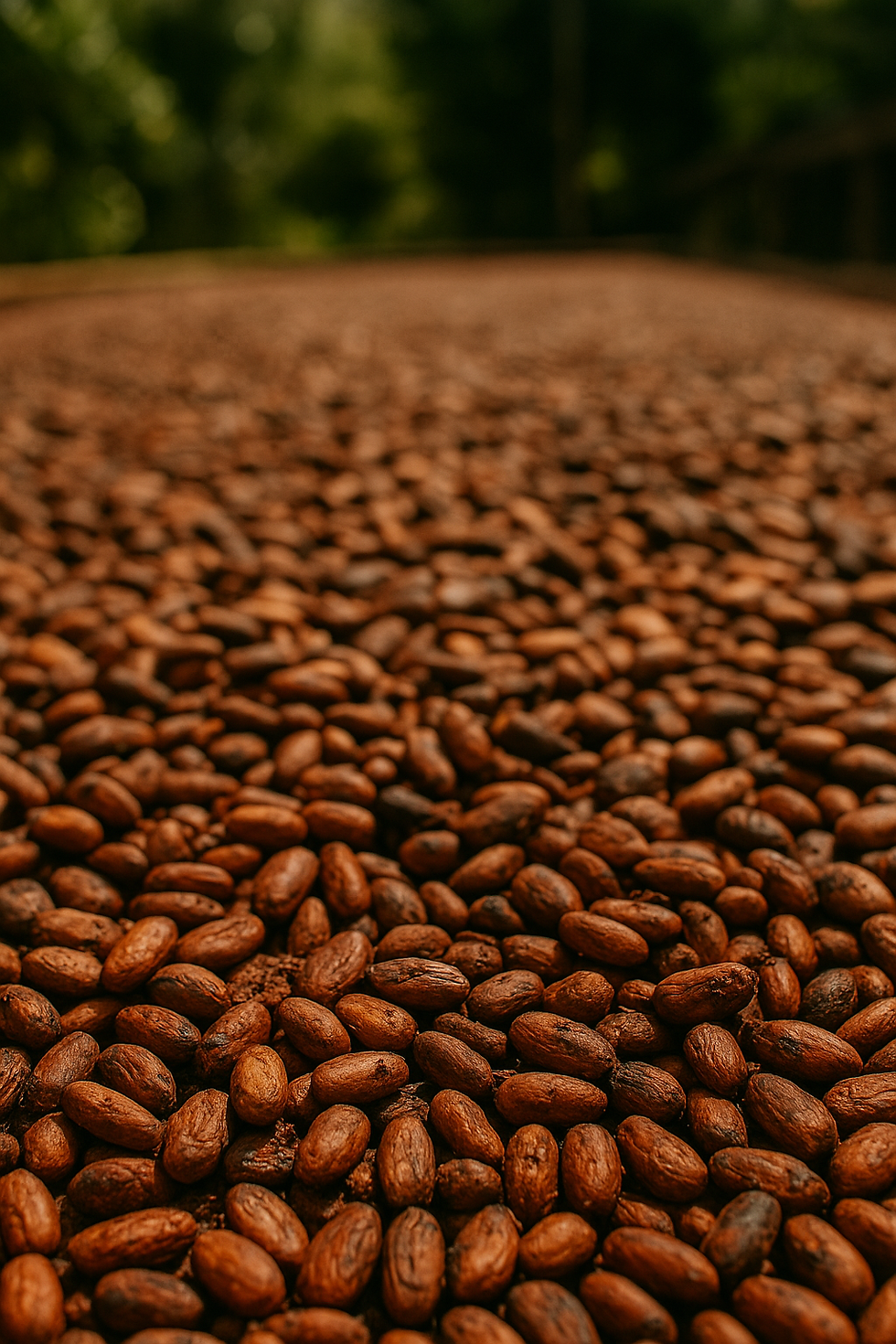
Start with the fruit. Cacao includes seeds and the pulp around them, and its culinary possibilities extend beyond the chocolate familiar today. Cacao has taken many forms across different places and periods.

The researchers’ account allows for cacao consumed as a beverage. But identifying cacao does not automatically recover a recipe. The evidence does not give us a reliable ingredient list, sweetness level, serving temperature, or preparation sequence for a particular ancient cup. [2]
An evocative illustration can invite us into the setting. The archaeological evidence does something different: it anchors the story to identifiable remains. We can appreciate both while recognizing that a reconstructed scene is an interpretation.
For a modern cacao drinker, the most rewarding connection may be the ingredient itself. Preparing cacao today can prompt curiosity about those earlier decisions without requiring us to claim that our cup reproduces an ancient ceremony.
6. A beginning already connected to a wider world
Santa Ana–La Florida was not necessarily an isolated starting point from which cacao followed one simple road. Ecuador’s cultural-landscape submission to UNESCO describes Pacific marine shells in funerary deposits at the site. Those objects point to connections between the upper Amazon and the coast. They do not, by themselves, trace a specific shipment of cacao. [5]
Later research gives that wider story more detail. A 2024 investigation examined residues from 352 ceramic objects associated with nineteen cultures. Its findings support cacao use outside the Amazon more than 5,000 years ago, while genetic mixtures point toward exchanges involving cacao from geographically distant populations. [4]
These findings suggest a history shaped by many communities moving plants and sharing knowledge. That is the next step in our series: following the evidence for cacao’s early journeys through South America, before turning to its later place in Mesoamerica.
What this first chapter changes
Beginning here changes the questions we ask. Instead of opening cacao’s story with the people who encountered it much later, we begin with the communities who knew the plant, prepared it, and helped shape its possibilities.
The discovery connects cacao to an ancient Indigenous community in the upper Amazon.
The combination of botanical, chemical, and genetic evidence makes the identification compelling.
The date provides a starting point in the surviving record, while leaving the deeper beginning open.
Connections beyond the site lead naturally into the history of exchange and movement.
At XOL, this is where we begin History of Cacao: with the people behind the ingredient and the evidence that helps us understand their world.
Next in the series
Explore other chapters already available: Beyond the Palace and From the Rainforest to Chaco Canyon. These visit later periods in the developing timeline.
Sources and further reading
[1] Zarrillo, S., and colleagues (2018). The use and domestication of Theobroma cacao during the mid-Holocene in the upper Amazon. Nature Ecology & Evolution, 2, 1879–1888. The original multidisciplinary study.
[2] University of British Columbia (2018). Sweet discovery: New UBC study pushes back the origins of chocolate. An accessible account of the findings and their interpretation.
[3] Valdez, F. (2019). Evidencias arqueológicas del uso social del cacao en la Alta Amazonía. Archaeological context and the social interpretation of cacao use. In Spanish.
[4] CIRAD (2024). Domestication of cocoa in pre-Columbian times: history revisited by archaeogenomics. Research summary accompanying Lanaud and colleagues’ Scientific Reports study.
[5] Permanent Delegation of Ecuador to UNESCO (2026). Ecuadorian Cacao Cultural Landscape. A national Tentative List submission, including the Palanda evidence and connections with the Pacific coast.
Image credits
Cover references: Santa Ana–La Florida aerial photograph (2025) and Mayo-Chinchipe-Marañón vessel photograph (2023), both by SimonLuzuriaga. Adapted into a painted composition with new lighting, landscape and lettering. Vessel reference: Museo Nacional del Ecuador, Quito. CC BY-SA 4.0


Comments