


History of Cacao: Part 8 — From Drinking Chocolate to the Chocolate Bar

A cup and a chocolate bar begin with the same seed. Yet the familiar bar—with its molded shape and smooth melt—emerged through a succession of changes in the workshop. During the nineteenth century, makers learned to separate cacao’s fat, recombine its ingredients, and work the mixture into new textures. Presses, mills, and mixing machines changed what chocolate could become.
The Work Of The Mill
Before chocolate reached a mold, cacao had to be ground. That demanding task became a field for mechanical invention. In Bristol, Joseph Storrs Fry patented a method of grinding cacao with a modified Watt steam engine in 1795. Steam power brought a new source of motion to work previously dependent on human, animal, or water power. [1]
Swiss manufacturers were experimenting too. François-Louis Cailler opened a mechanized chocolate factory near Vevey in 1819. In 1826, Philippe Suchard developed a mélangeur for mixing cacao and sugar. These workshops were solving practical problems: how to mix ingredients thoroughly and produce larger quantities with a consistent texture. [2]

What The Press Separated
In Amsterdam, Casparus van Houten’s cocoa press marked another important development in 1828. Ground cacao contains cocoa butter, the seed’s natural fat. Applying pressure separated some of that butter from the remaining cocoa material, which could be made into powder. A single raw ingredient now yielded components that makers could handle separately. [3]
The consequences reached both cup and confectionery. Powder offered a less fatty base for a drink; the extracted butter became an ingredient in its own right. Van Houten’s son Coenraad also developed alkalizing, later known as Dutch processing. This changed cocoa’s flavor and color. Pressing out fat and treating cocoa with alkali were distinct operations, each opening a different way to alter the finished product. [3]

A Mixture That Would Set
Chocolate had already been sold in solid forms. The Sprüngli business, for example, records making solid chocolate in Zurich in 1845. The important nineteenth-century development was a growing range of chocolate intended to be eaten directly, with recipes and machinery designed for that purpose. [4]
In 1847, Fry’s in Bristol introduced its molded eating chocolate. The Smithsonian’s collection history describes a process of removing cocoa butter and then adding it back into the chocolate. Control over the fat helped makers produce a mixture that could be shaped in molds. The bar’s history was therefore closely connected to the same separation process that had helped transform drinking cocoa. [1]

Milk Enters The Mixture
A further challenge occupied Daniel Peter in Vevey: combining milk with chocolate in a form that would keep. His experiments culminated in a milk-chocolate breakthrough in 1875. The technical problem involved moisture, as well as taste. Peter developed a method of dehydrating milk and incorporating it into chocolate. [2][5]
Milk became part of the chocolate itself, rather than simply a liquid added to a cup. This added another branch to the growing family of eating chocolates, alongside the darker mixtures already being produced.
The Texture Of Time
In Bern in 1879, Rodolphe Lindt developed conching. Chocolate mass was worked and aerated over time, producing a smoother, more fluid mixture that could be poured into molds. Lindt called the result chocolat fondant: melting chocolate. [4]
Conching was a mechanical process with a sensory result. Research into chocolate’s flow shows how sustained mixing helps turn a crowded mixture of solid particles and fat into a flowing suspension. The machinery was changing how chocolate moved in the factory—and how it felt in the mouth. [6]

By the end of the century, pressing, mixing, milk processing, and conching had expanded chocolate’s possible forms. Drinking chocolate continued, while eating chocolate acquired new shapes and textures. Behind the cup and the bar stood an expanding network of factories, shipping routes, and cacao farms. The next chapter follows the changing geography of those farms.
Sources
[1] Smithsonian National Museum of American History, J. S. Fry & Sons Cocoa Tin, collection history.
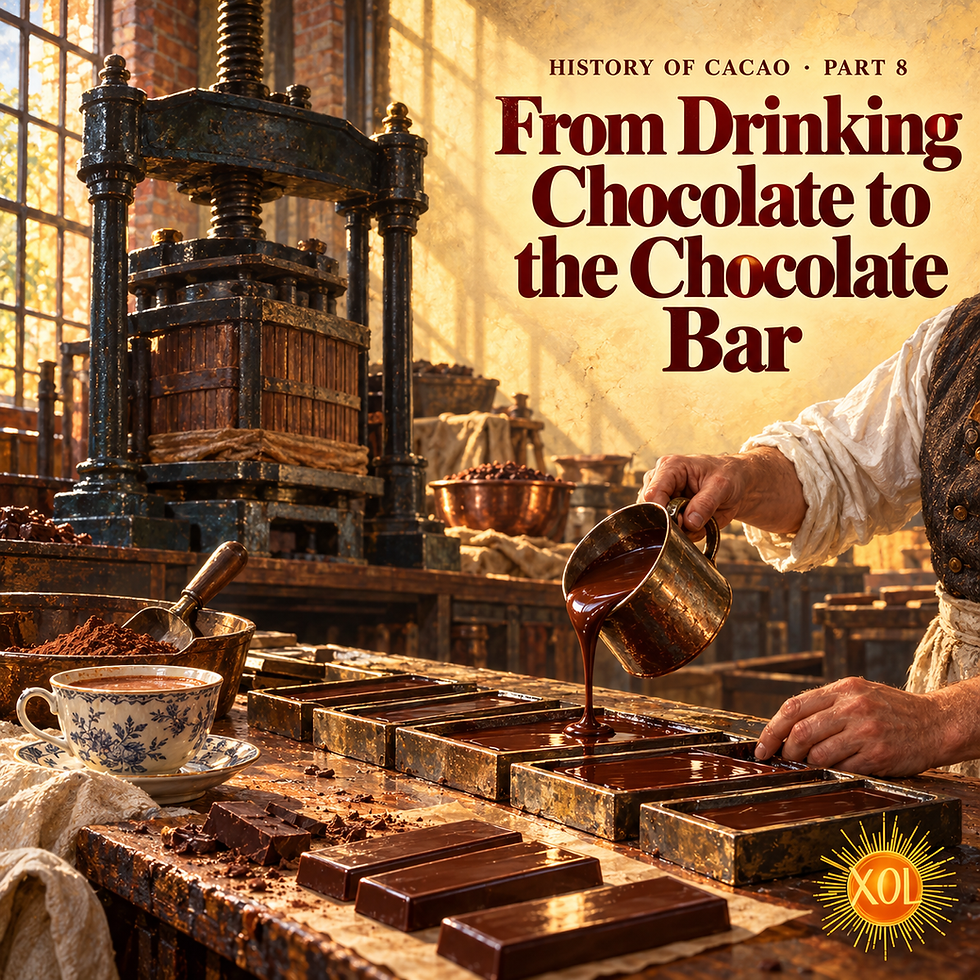
Cover: an imagined late-nineteenth-century chocolate workshop. Original painting informed by the Van Houten historical press illustration.


Comments