


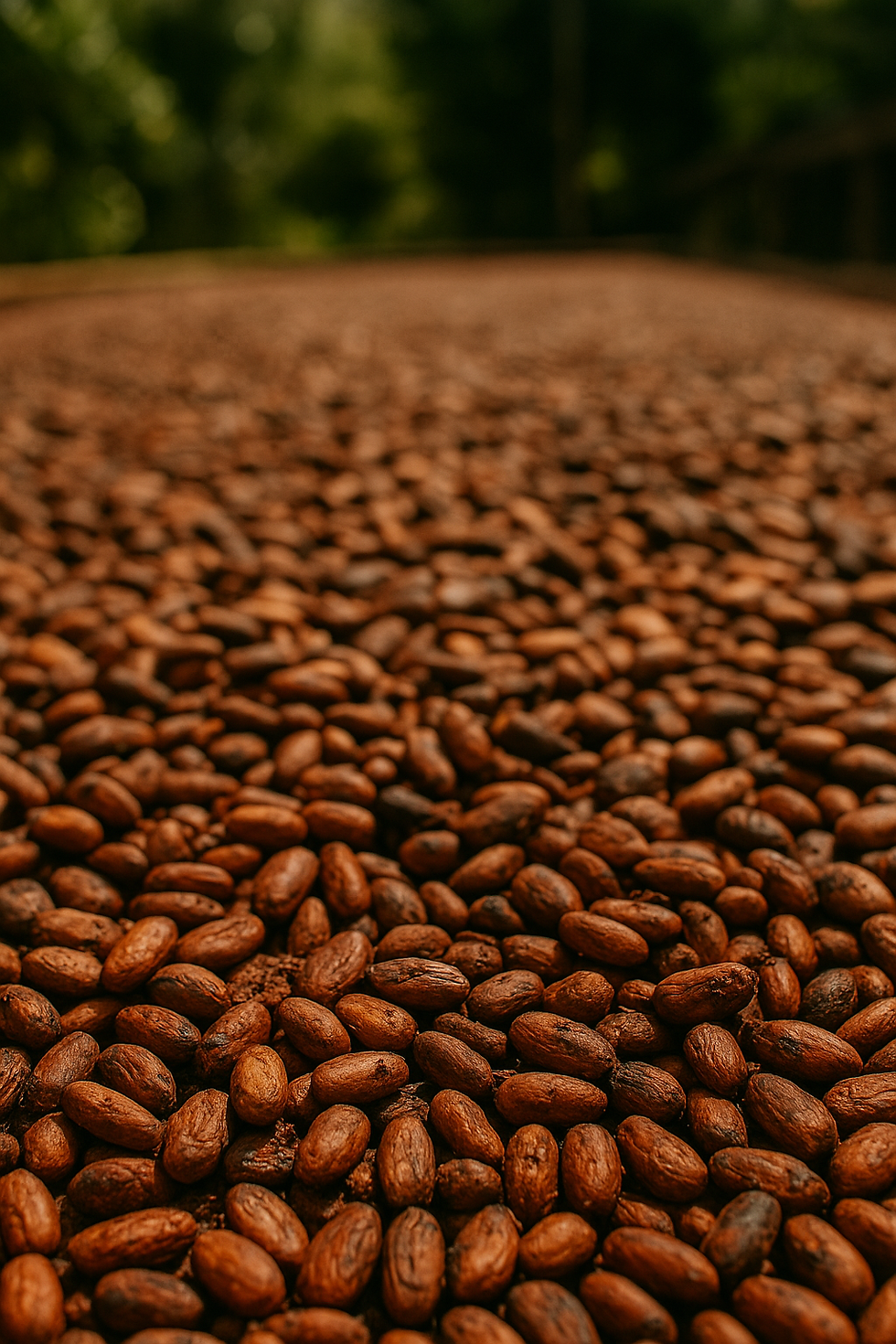

How Farmers Assess Fermentation — What a Cut Test Can Tell Us

TRANSFORMING CACAO • FIELD NOTES
A dried cacao bean keeps much of its history hidden beneath its shell. Cutting it open exposes the cotyledons—the seed leaves that become nibs—and gives a buyer or producer a practical way to inspect the lot. The result is useful evidence, but it is not a complete flavor score.
What the test examines
The Federation of Cocoa Commerce definitions reproduced in the industry quality guide describe a cut test as an examination of exposed cotyledons for defective, slaty and purple beans, as well as contamination. Internal mold and insect damage count as defects. [1]
A useful result describes a sample, not one attractive bean selected from a bag. For commercial grading, the sampling procedure, number of beans, classifications and acceptance limits must follow the applicable method or contract. A casual inspection can raise questions; it should not be presented as a formal grade.
Why color helps—and can mislead
Slaty interiors are associated with insufficient fermentation and can produce pronounced bitterness and astringency. Fully purple beans can also contribute these characteristics. But the aim is not necessarily a sample in which every bean is uniformly brown: properly harvested, fermented and sun-dried cacao may still contain partly purple-brown beans. Planting material also influences astringency and polyphenol composition. [2]
This is why color needs context. Record what is present rather than forcing every lot into a universal ideal. Comparing results with the producer’s fermentation records is more useful than assuming that a single color reveals an exact number of days.
What it cannot tell you
Industry guidance explicitly separates visible grading from complete flavor evaluation. A cut test may flag likely problems, including severe bitterness, mold-related notes or signs associated with over-fermentation. It cannot describe the whole sensory character. That requires preparing the cacao through controlled roasting and processing, then tasting it. [3]
A clean-looking interior also does not constitute a laboratory test for microbial or chemical hazards. Visual quality assessment answers a narrower question: what can be observed in the sampled beans?
How professionals connect inspection and tasting
Cacao of Excellence begins with whole-bean inspection and aroma, then records cut-test characteristics. Cut-bean aroma informs selection of roasting conditions. Accepted samples are subsequently made into cacao mass and assessed blind by an expert panel. The visual inspection is one stage in a sequence, rather than the final verdict. [4]
For a small producer, the useful habit is to keep the evidence connected: lot identity, sampling date, observations, processing records and tasting notes. If a lot looks good but tastes unusually harsh, the disagreement is worth investigating. Do not discard the tasting result simply because the cut surfaces appeared satisfactory.
Follow the process behind these changes in Fermentation — How Cacao’s Flavor Begins, then continue to Sun Drying — Preparing Cacao for Its Journey.


Comments